
The future mobile work machine is not built by the best OEM in the world. It is built by the best ecosystem in the world. That ecosystem is right here in Finland. GIM is committed to helping build it — through SIX MWM, through the strategy, and through the work we do with our customers and partners every day.
This Blog post presents our commitment to the Finnish mobile work machine industry — and to the Mobile Machine Growth Strategy 2035.
By Jari Saarinen, CEO and co-founder, GIM Robotics.
We have always believed in ecosystems
GIM Robotics is a small company. Forty robotics professionals, working from Espoo, building 3D LiDAR-based autonomy software for mobile work machines.
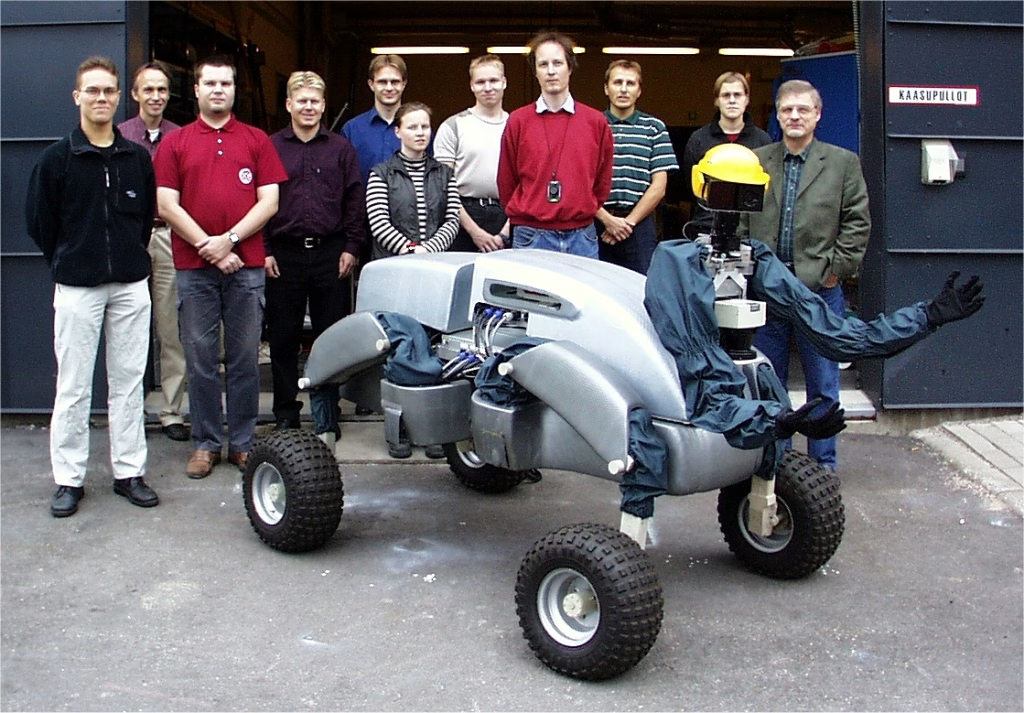
What people sometimes overlook is how much of our work — both before and since the company was founded in 2014 — has happened inside ecosystems. Our scientific lineage runs back to the Intelligent Machines Group at Aalto University (formerly Helsinki University of Technology), which has been working on autonomy in heavy mobile machinery since 1985. We were among the founding members of FIMA (Forum for Intelligent Machines) back in 2006, when the people who later founded GIM Robotics were still operating from academia. Since then, we have been a Solution partner of the SIX Mobile Work Machines cluster for many years, and have contributed wherever we could to the joint development of the Finnish industry.
So, when we talk about the importance of ecosystems, we are not making a fashionable statement. We are talking about the way we have been working for two decades — in some sense, for four.

A new, stronger SIX MWM
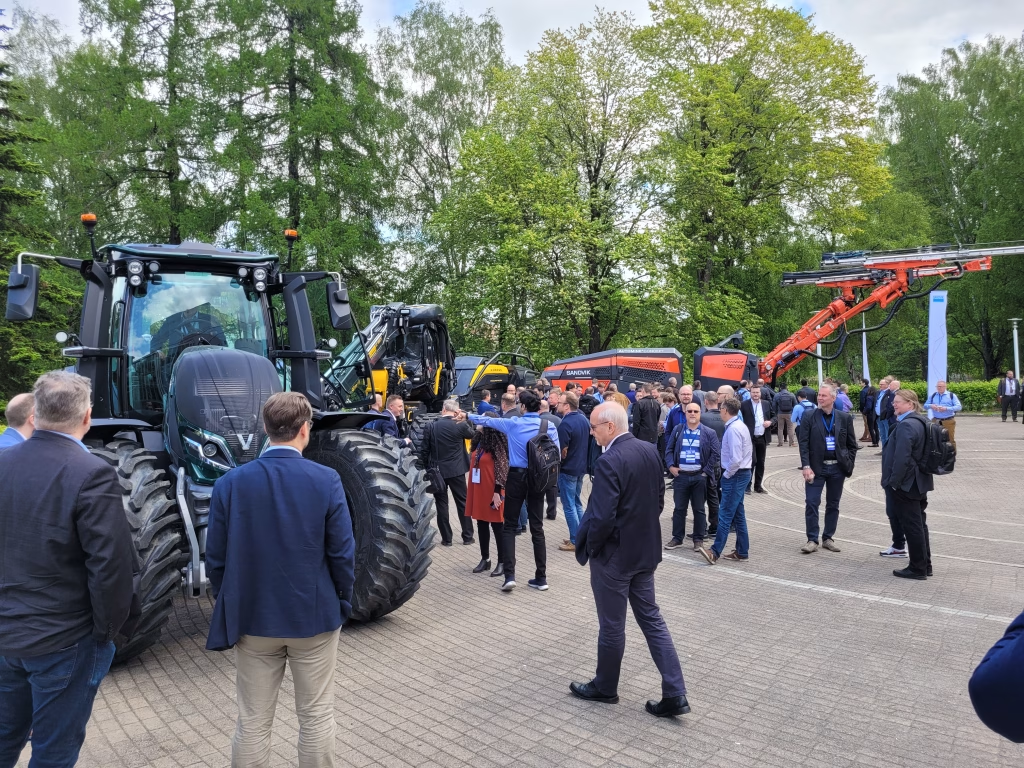
Earlier this year, FIMA and the SIX Mobile Work Machines cluster merged. The new SIX MWM is now in full operation: a single, focused organisation representing OEMs, technology providers, and academic partners across the Finnish mobile work machine industry. We think this is an important step. A united industry organisation has more credibility with policymakers, more leverage with investors, and more bandwidth to do the substantive work that ecosystems exist to do.
That work, in our view, comes in three forms:
- Sharing a vision for the future of the industry. No single company has the right to decide where this industry is going. An ecosystem is the place where the picture of where we are heading gets agreed on, refined, and revised. Without that shared picture, we end up with forty companies pulling in slightly different directions — and a country that struggles to be more than the sum of its parts.
- Sharing information. Some kinds of knowledge must be shared early to be useful: how regulations are evolving, what technology trends are starting to bite, what is happening in adjacent industries, what works in one operating environment that hasn’t yet been tried in another. Ecosystems are how we move that knowledge faster than the news cycle does.
- Actively supporting and steering research. Industrial research is most useful when industry helps shape it — what to study, what to leave for later, what is genuinely worth a ten-year investment. That alignment doesn’t happen by accident. It happens because companies and universities meet in ecosystem-level forums and do the work of agreeing on priorities. SIX MWM, like FIMA before it, is one of those forums. We intend to keep showing up.
A national strategy worth standing behind
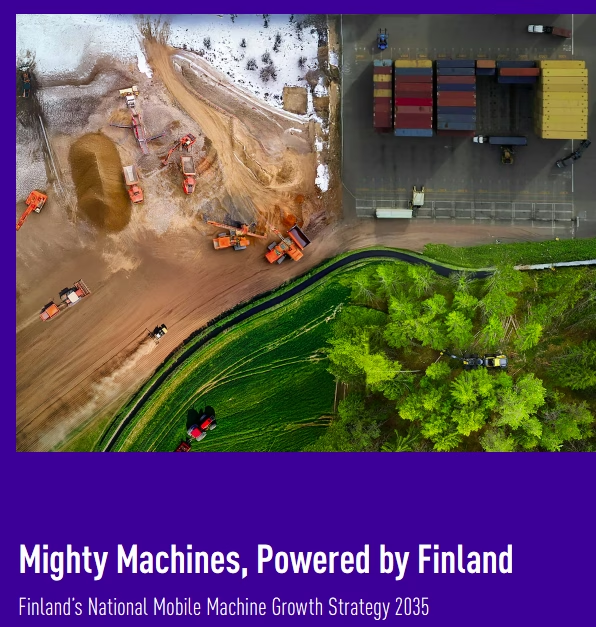
One of the most important tasks of the new SIX MWM is to implement the Mobile Machine Growth Strategy 2035 — Finland’s national strategy for our industry, published in 2025.
The strategy in short: Mobile work machines are one of Finland’s most important industries: about €19 billion in annual revenue, around 45,000 employees, and 10–15 % of Finnish goods and services exports. The vision is to set Finland’s mobile machine industry as the global standard for mobile machines and solutions with superior customer value, and to triple industry revenue by 2035. That implies roughly ten percent annual growth and the creation of up to 45,000 new jobs.
To get there, the strategy identifies eight priorities, organised in two groups. Four are about reaching a global leadership position: customer-centric value creation, differentiated high-impact solutions, smart and AI-powered machines, and sustainable solutions at scale. Four are about the enablers behind that: seamless collaboration, an attractive operating environment, a highly skilled workforce, and focused primary and applied research.
Our take on the strategy
The listed priorities are spot-on. The priorities are not controversial; they are obvious. The harder, more important question is what will change when those priorities are written down and shared among the relevant stakeholders.
In our view, three things will change.
- Mobile work machines are now recognised as an industry — big and important. Until now, the industry has been visible mostly to the people inside it. The strategy makes it impossible to mistake it for anything other than what it is: forty thousand people, nineteen billion euros of revenue, more than a tenth of national exports.
- It is recognised as a viable, growing industry that creates jobs in Finland. The strategy doesn’t just describe the industry today. It commits to growing it. Forty-five thousand new jobs by 2035 is not a marketing line; it is a target the entire ecosystem is now working toward.
- It gives the industry a long-term frame. Most companies, including ours, run on quarterly and annual planning cycles. A national strategy with a ten-year horizon gives us permission to think further out — to invest in things that will pay back beyond the next budget round, and to expect that our partners are doing the same.
Why does any of this matter? Because writing it down influences everyone whose decisions shape the industry’s future:
- It gives us a joint voice when we speak with decision-makers. Forty companies asking for one thing is a lobbying campaign. An entire industry asking for the same thing is a national priority.
- It creates trust with decision-makers and investors. Capital and policy attention go to industries that look credible and coordinated. The strategy makes Finnish mobile work machines look like exactly that.
- And — most importantly to us — it sends a strong message to young people deciding what to study today. To a sixteen-year-old choosing between a path that obviously has a future and one that doesn’t, the existence of a published, ambitious national strategy is a real factor. The same applies to the international talent we are trying to attract to Finland: when the country has a clear story about which industries it intends to be world-class in, that story changes the answer to “should I move here for this job?”
How a company aligns with the strategy
GIM was recently invited to give a talk at the SIX MWM Result Seminar about how companies can align with the national strategy and where the opportunities are. The rest of this post is adapted from that talk.
I’ll take it in three parts: where the alignment is easy, how a forty-person company can map onto each of the eight priorities, and the future I think the strategy is genuinely worth aligning ourselves with.
Where alignment is easy
Some parts of aligning with the strategy are straightforward.
Growth. The strategy targets approximately ten percent annual growth across the industry. GIM’s own targets are higher — twenty percent annual growth in project sales and a doubling of product revenue every year. Our internal numbers already commit us to outgrowing the national average.
Exports. Mobile machines are 10–15 % of Finnish goods and services exports. The majority of GIM’s revenue is export, and that share grows year on year. The strategy’s export ambition is, for us, a description of where we already operate.
Advocacy. We try to actively reference SIX MWM and this strategy in our international engagements. We sent the strategy to the President of the VDMA Robotics & Automation group, with the suggestion that something similar would be useful at the European level and we are continuously publishing news and blogs about these topics. Small actions — but if all of us in the industry do similar small actions, the strategy becomes visible to the people whose decisions matter.
Education. We hire from the doctoral pipeline, we participate in research programmes, and we publicly support stable, long-term funding for higher education. The strategy is right that focused, deep university research is one of our few durable competitive advantages.
That part of alignment is, frankly, easy.
Eight priorities, one company
The harder and more useful question is how a forty-person company contributes across all eight strategic priorities.
Reaching global leadership
Customer-centric value creation. Our mission is to exceed customer expectations. We do that in two ways. First, we bring technology our customers could not realistically have built in-house — fifteen years of focused work on a single hard problem. Second, we work multi-industry, so a finding from a forestry harvester this quarter often lands as a tested capability on a port crane next quarter. That cross-industry transfer is something an OEM, by definition, cannot do alone. Two-week sprints and a flat structure are the operational form of that work; they are not the substance.
Differentiated, high-impact solutions. We are good at many things. We are the best at one — 3D LiDAR-based perception and localisation. We do not try to cover every autonomy use case; we specialise where 3D perception is the bottleneck. Finnish competitiveness depends on exactly this kind of focused leadership: in a defined niche, simply be the best, and let the rest of the ecosystem rely on it.
Smart, AI-powered machines and operations. This priority is our core. Our role is to keep being at the tip of technological development in our niche and to transfer that know-how to our OEM customers. We don’t build the machines. We make sure that when a Finnish OEM builds one, the autonomy layer inside it is one of the most advanced anywhere in the world.
Sustainable solutions at scale. Sustainability in this industry happens at scale or not at all. An electric vehicle that needs a human operator competes with diesel; an electric autonomous fleet does not. Our contribution is the autonomy layer that makes electrified, lower-impact operations economically viable.
The enablers
Seamless collaboration. This is the priority where our company values matter most directly. We try to be a straightforward, honest, competent partner — and that reputation, in our view, is an asset of the same order as the technology. Operationally, we are active members of SIX MWM, and we want to be builders of the ecosystem roadmap, not just consumers of it. The roadmap is not a static document; it must be revised continuously, and we want to be in the rooms where that happens.
Attractive and predictable operating environment. Mostly a policymaker priority — but companies have a small role. We bring foreign customers and partners to Espoo, host visits, and try to make the depth of the Finnish ecosystem tangible to people deciding where to invest their R&D money.
Highly skilled workforce. Forty senior roboticists is a small number, but the level is high. We invest meaningfully in our own people, and we participate in doctoral programmes — not as marketing, but because the next decade of this industry literally needs the engineers we hire and train today.
Focused primary and applied research. Our scientific lineage is in Aalto’s Intelligent Machines group, which has been investing in this area since the 1980s. The honest version of GIM’s history is that it took thirty years of public research funding before our core capability was ready to commercialise — that is the horizon focused research must operate on. Our role today is to be the bridge: to translate research outcomes into productised software, to co-author research roadmaps, and to be a credible industrial partner for funded programmes.
The point is not that we touch all eight priorities equally — we obviously don’t. The point is that a small, specialised technology company, properly placed in the ecosystem, has a concrete role in every one of them. That is how a national strategy gets implemented in practice: not by a master plan, but by each company finding its place inside it.
The future
Ten years from now, the most advanced mobile work machine on a customer site anywhere in the world should carry the work of a Finnish ecosystem. An OEM that knows its customers’ operations better than anyone, partnered with technology providers that are world-class in their own niches. Perception. Fleet management. Power systems. Operator interfaces. Safety. Each delivered by a company that has earned the right to be there.
That is the future where Finland wins. Not by trying to be vertically integrated giants, but by being a country whose ecosystem is so well specialised, so well coordinated, and so well connected to its own research base, that no closed competitor anywhere can match what we put together on a customer’s site.
We think this is reachable. The strategy points in the right direction. The talent is in this country. The trust between our companies is real. What is left is mostly operational — to keep choosing partnership over isolation in the architectural decisions we make every quarter, and to move at the cadence the strategy implies.
There is, of course, a risk. If every OEM tries to build everything themselves, the development speed is not fast enough, and the result is not good enough. Not because anyone in the Finnish mobile machine industry lacks ambition or capability — but because the technology surface of a modern mobile work machine is now too broad for any single company to be world-class at every layer of it.
But the opportunity on the other side is bigger than any one of our companies.
SIX MOBILE WORK MACHINES: https://www.six.fi/mobile-work-machines
The full program: SIX Mobile Work Machines Result seminar 2026
Finland’s National Mobile Machine Growth Strategy 2035 Report: Mighty Machines, Powered by Finland
