
This is the time of the year when strange things start to happen. The world is preparing for Xmas and if you skip the religious part of it, the magic is naturally related to the smiling bearded character we know by different names. For us Finns he is called Joulupukki, after all he lives in Northern Finland, in Lapland, in a place called Korvatunturi. Others might call him Father Christmas, or Santa Claus. Most widely he is probably known as plain Santa.
SANTA, THE SUPERHERO
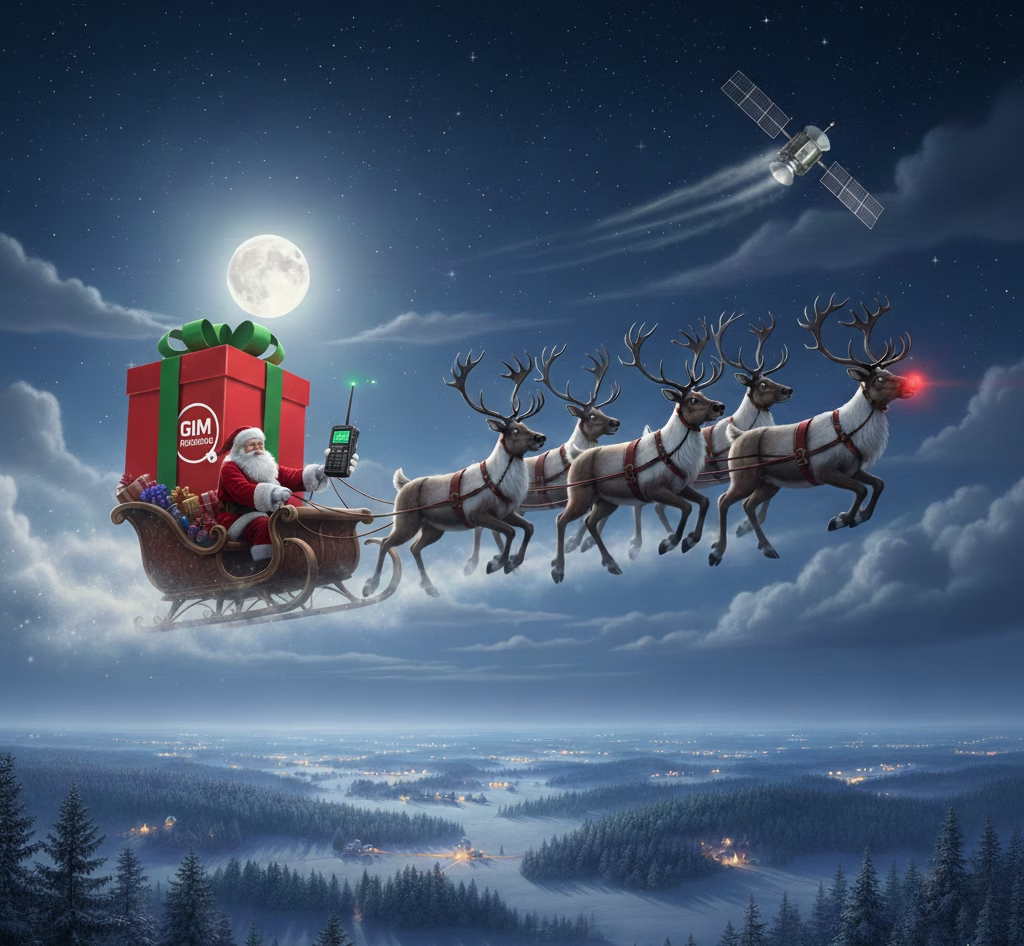
There are many great stories about his wonderful adventures during Xmas time. We all know about his astonishing skill of squeezing down even the narrowest chimney with his big belly and huge sack filled with gifts for all those well-behaved kids. Likewise, we all know about his reindeer powered sledge and about his famous path illuminating reindeer called Rudolph. But the most wonderful and most intriguing aspect of Santa’s Xmas activities is undoubtedly his unearthly ability to move so fast that he can deliver all the gifts globally in such a short time. Time zones obviously assist in that, but there must be something else; something related to Santa’s ability to navigate flawlessly globally.

FLYING REINDEER ARE AMAZING
We don’t even want to start guessing how Santa was doing it back in the days but rather restrict our ponderings to the modern era filled with all sorts of technical gadgets and systems, which could assist him in it. When you consider navigation in robotics, you usually divide it into localization, mapping and motion planning – which itself consists of path-planning and control. When talking about intelligent well-trained flying reindeer, we can be pretty sure that the animals take care of the mapping and motion planning: mapping because they have pretty good view of the landscape from the sky and motion planning because reindeer are known for their cyclic migratory behaviors and by favoring living in herds, especially during those times.
BACKUP FROM SATELLITES
That leaves the localization part. How on earth can reindeer localize themselves, especially in modern times when landscapes are changing constantly, partly due to natural reasons, but more importantly due to our ever-increasing desire to change our urban habitat, and nature in general, at ever increasing speed. As we are engineers, and not biologists, we can only guess the ways they do it. Some animals are using magnetic fields and polarized light for their localization, so maybe, at least the special bloodline of Santa’s flying reindeer has been using them as the foundation for their localization. Like humans, animals are likewise known to make mistakes, and for that reason we are pretty sure that Santa has been familiar with the Global Navigation Satellite System (GNSS) since its introduction. Most probably Santa has let the reindeer do their thing, and only when the situation starts to get really difficult, he has supported them with reliable real-time position information from his satellite receiver – at least we believe so.
PROBLEMS ON THE SKY
That brings us nicely to the matter at hand; to the problems Santa has reportedly faced when taking his sledge for test runs well before Xmas time. As his home is in Korvatunturi, which is situated pretty close to the borderline between Finland and our Eastern neighbors, he has noticed that his GNSS receiver has behaved very weirdly. Sometimes the position has jumped suddenly from Lapland to Sweden and sometimes it has been moving steadily on a large circle – all that while Santa has been resting and feeding Rudolph and the boys. So, there is definitely something funny happening at the moment. As this is a Xmas post, and as such it should be full of joy, happiness and love, there is no need to go into details, other than state that something or somebody is jamming and spoofing the GNSS signals.
WHO YOU GONNA CALL?
GIM Robotics has been offering accurate localization for field and service robots and modern mobile work machines since the company was founded in 2014. Although we excel in all-weather outdoor use cases where GNSS signal is compromised or even non-existing, RTK-GNSS signal is used when available and proven reliable. To secure the satellite signal in most situations, even in those cases when Dr. Seuss’ Grinch, any folklore figure like Krampus, or the little green men from the East would want otherwise, we have taken actions to make it reality. And when we Europeans are talking about something coming, basically from space, or at least from altitudes very high above our beloved Earth, who are you going to call? Well, obviously you will call the European Space Agency (ESA).
LEO, THE KING
Preventing jamming and spoofing is not an easy task. You can create all sorts of mechanisms to protect the signal, but the issue is that every time somebody manages to generate, even into a small and restricted area, a stronger signal than the one you are supposed to receive for your own purposes, things are turning ugly. There are naturally some ways to mitigate this risk, but none of them is quite as elegant as the idea of Low Earth Orbit (LEO) satellites. As they are much closer to Earth than the traditional GPS satellites, the signal can be even 100 times stronger, and it provides much better security due to encryption and authentication. In addition, it enables superior accuracy when compared to standard solutions.
NEW ESA PROJECT OFFICIALLY LAUNCHED
Based on the above, we are all thrilled to be part of an ESA funded project where production-class satellites are put to space to form a new commercial constellation of approximately 300 satellites. In the project there is a well-funded company who is actually putting those satellites up, another world-leading designer and manufacturer of high-precision GNSS receivers, who have already integrated the LEO satellite signal into their receiver. In addition, our project partners include one of the leading European institutions working on the next generation of navigation using Low Earth Orbit satellite and one Finnish deep-tech start-up with razor-sharp focus on localization related solutions.
ADULTS ARE JUST GIANT KIDS
In the official ESA contract papers, we stated that we are integrating the LEO signal into our localisation solutions and test & verify how the new modality improves our solutions’ accuracy and reliability. The integration will no doubt provide us many benefits, which will be communicated later in greater detail. But the real reason why we joined the consortium is our desire to help Santa in his massive annual task, when he is distributing Xmas presents to nice children – and to us adults. By doing that we are doing our best to stay away from the Naughty List. Who wouldn’t?
Merry Christmas!
P.S. If you want to read more about how GIM Robotics has tried to help Santa during the Xmass times, just click the link below. Make sure to have a cup of coffee, tea, hot chocolate or any of your favorite beverages, because it is going to take some time to go through them all…
